I Deleted My Best Statistic Two Days Before the Boston Globe's B-Side Cited Me
BagRescue earned media coverage with proprietary market data. The more important lesson: knowing which impressive claim to delete is part of the product.
Two days before the Boston Globe's B-Side cited BagRescue, I deleted one of the cleanest statistics in our Boston market guide.
The number was real. The label was wrong.
We had grouped Too Good To Go storefronts by ZIP code and translated those groups into familiar Boston neighborhood names. It made for a great headline: these are the neighborhoods with the most surprise bags.
It was also too loose. Boston ZIP codes do not respect the neighborhood boundaries Bostonians actually use. One group we called Beacon Hill also included Downtown Crossing and Boston Public Market. Another reached from Fenway into Back Bay, Allston, Longwood, and Mission Hill.
So I removed the ranking, published a correction, and told the reporter exactly what the data could—and could not—support.
The story still ran.

The Story Was the Data
The Boston Globe's B-Side, published on Boston.com, was working on a guide to Boston's Too Good To Go scene. Reporter Kelly Chan found BagRescue's data-backed Boston market guide, asked about the analysis behind it, and interviewed me.
Our July 27 scan had returned 749 bag listings from 385 storefronts within 25 miles of downtown Boston. That distinction matters. A single Whole Foods can offer bakery, prepared-food, produce, and grocery bags from one address. Four listings. One storefront.
The defensible findings were still interesting:
- Whole Foods and Caffè Nero represented about 46% of Greater Boston listings.
- Baked goods made up 30% of the regional category mix.
- Cambridge returned 73 listings across 37 storefronts.
- Among BagRescue users monitoring Whole Foods, meat and seafood bags drew the most demand.
The B-Side story cited BagRescue several times, linked readers to the underlying guide, and used our customer behavior to explain which bags were hardest to land.
Not because our marketing copy was clever. Because we had information the reporter could use.
Lesson 1: Build the Source, Not the Press Release
Most startup PR is a company asking the world to care that the company exists.
New feature. New partnership. New milestone. Revolutionary. Transformative. Proud to announce.
Nobody cares.
Reporters need evidence, context, and a story their readers already have a reason to care about. BagRescue could answer practical questions about a market people in Boston were actively using:
- Who supplies most of the bags?
- What kinds of food show up?
- Where is the selection concentrated?
- Which bags disappear fastest?
- Why are some bags nearly impossible to reserve manually?
That is a much stronger marketing asset than a founder bio or press release. It makes the product useful before anyone becomes a customer.
Lesson 2: Specificity Beats Brand Language
"Boston has a vibrant food-rescue scene" is filler.
"Whole Foods and Caffè Nero account for nearly half of the region's listings" is information.
One can be generated by anyone. The other requires a product capable of observing the market.
This is the content moat founders miss. If your software sees something the rest of the market cannot easily see, your operational data can become distribution. Not raw customer data. Not a dashboard screenshot. Aggregated, anonymized insight that answers a real question.
The narrower the question, the more useful the answer often becomes. "The state of food waste" is broad and forgettable. "What is actually available on Too Good To Go in Boston?" is specific enough to search, cite, and act on.
Lesson 3: Methodology Is a Marketing Feature
The temptation was obvious. Keep the neighborhood ranking. It was clean, local, and highly shareable.
But the data did not support that level of precision.
We kept the city-level counts because municipal boundaries were reliable. We kept the chain and category analysis because those definitions were explicit. We described meat and seafood as preferences among BagRescue users, not universal behavior across every Too Good To Go customer.
And we showed our work.
That restraint made the remaining numbers more credible. A limitation is not an embarrassing footnote. It is proof that somebody is thinking about what the data actually means.
Trust is not separate from growth. Trust is what makes a reporter comfortable citing you, a reader comfortable sharing you, and a customer comfortable connecting an account to your product.
The Data-to-Distribution Flywheel
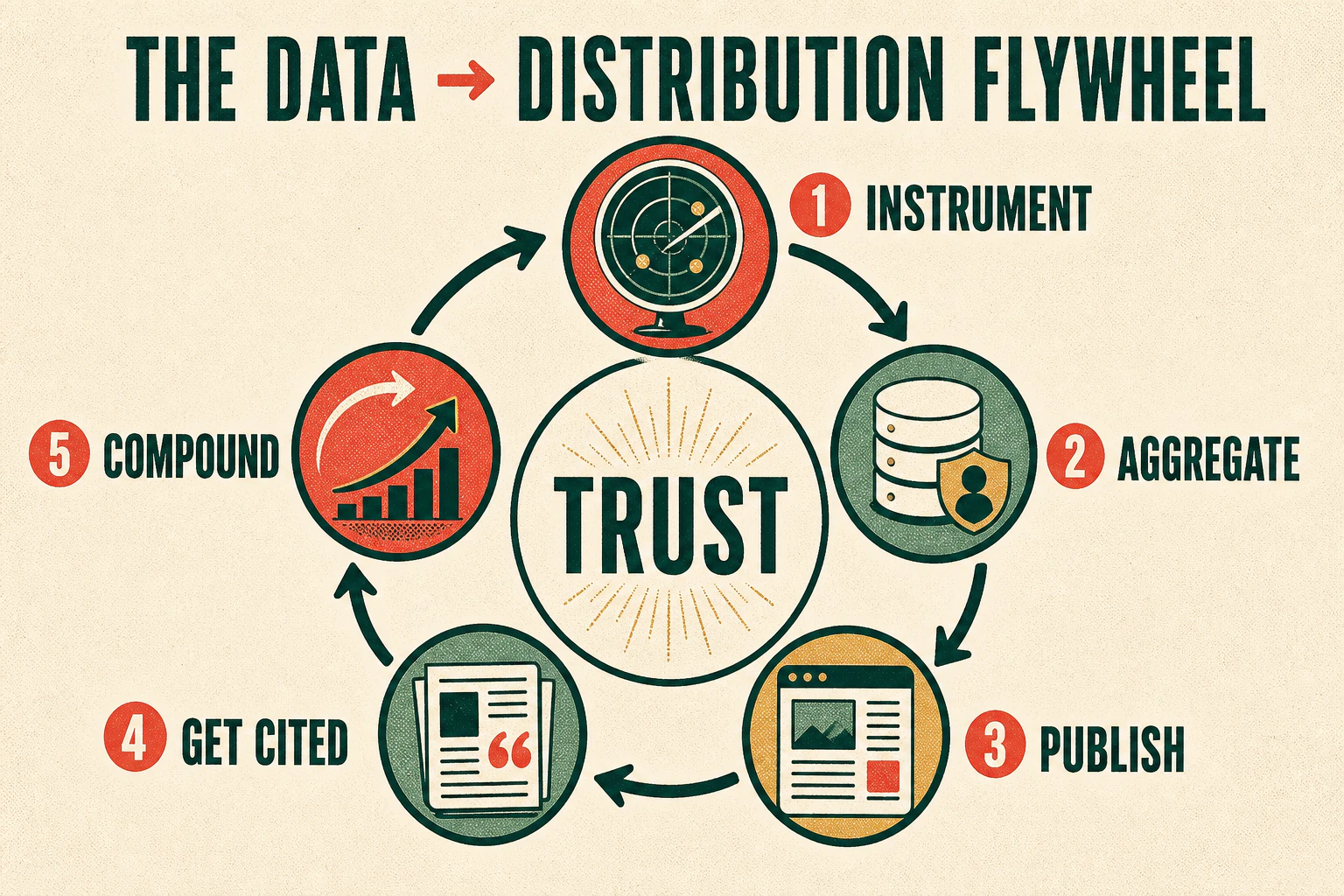
The loop looks simple:
- Instrument the product. Capture the operational events required to make the product work.
- Aggregate responsibly. Remove personal information and separate observed facts from inference.
- Publish something useful. Answer a narrow question with specific findings and a visible methodology.
- Earn discovery and citations. Searchers, communities, and reporters find a source rather than a sales pitch.
- Compound authority. Good coverage creates links, branded search, customers, and eventually a richer dataset.
Then the loop starts again.
The important word in the middle is trust. Remove it and the flywheel becomes a content mill: more pages, weaker claims, declining credibility. Keep it and every analysis makes the next one easier to believe.
What I Would Do Again
This experience changed how I think about product marketing for every data-rich product I build.
I would:
- Instrument for potential aggregate insight from day one.
- Publish focused city and category analyses instead of generic thought leadership.
- Put definitions, sample dates, and limitations next to the findings.
- Maintain a correction log rather than quietly rewriting mistakes.
- Give reporters a clean source page with the underlying numbers.
- Track referral traffic, branded search, and signup quality—not just the headline.
I would also resist turning every observation into a dramatic claim. If a dataset cannot answer the question, saying so is part of the answer.
Earned Media Is a Lagging Indicator
Being cited by B-Side is flattering. It is not an endorsement, and it is not the strategy.
The strategy was building a product that saw something useful, turning that observation into a defensible public resource, and making the methodology clear enough for someone else to trust.
The media mention was a lagging indicator that the work had become useful outside the product itself.
That is the product and marketing lesson I am keeping:
If your product can see something the market cannot, do not bury it in an internal dashboard. Make it legible. Make it useful. And when the data cannot support the prettier story, delete the prettier story.
Trust compounds longer than any headline.